EM propagation at oblique incidence to an interface between dissimilar dielectric media
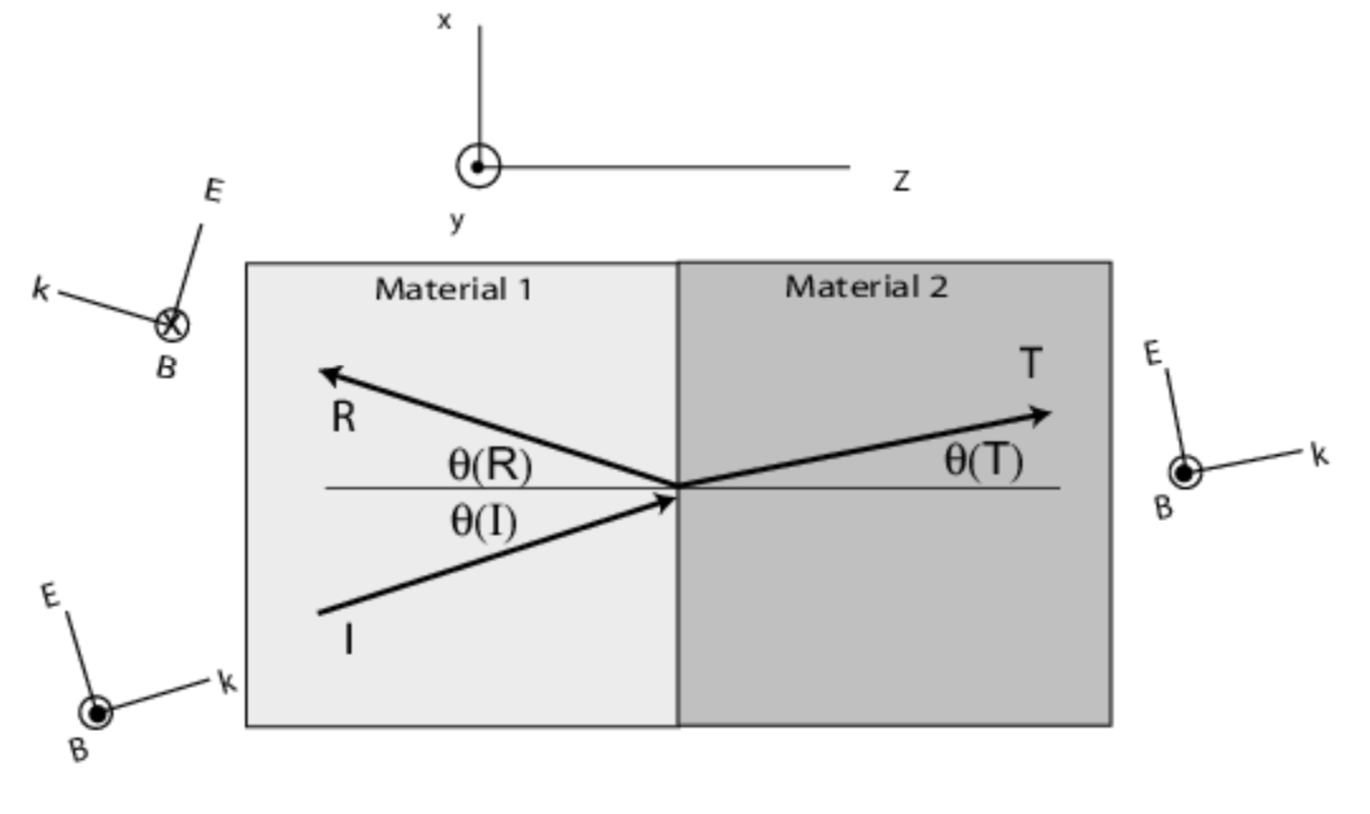
From EM-class we know $$ \begin{align} E_I \cos \theta_I + E_R \cos \theta_R &= E_T \cos \theta_T, \\ \epsilon_1 (-E_I \sin \theta_I + E_R \sin \theta_R) &= -\epsilon_2 E_T \sin \theta_T, \end{align} $$ this can be simplified to $$ \begin{align} 1 + r &= \alpha t, \\ 1 - r &= \beta t, \end{align} $$ where \( \alpha \) and \( \beta \) are defined as $$ \begin{align} \alpha &\equiv \frac{ \cos \theta_T }{ \cos \theta_I}, \\ \beta &\equiv \frac{ n_1 }{ n_2 } \frac{ \epsilon_2 }{ \epsilon_1 }. \end{align} $$ From above we can derive $$ \begin{align} t &= \frac{ 2 }{ \alpha + \beta }, \\ r &= \frac{ \alpha - \beta }{\alpha + \beta }. \end{align} $$ We can even delve further that $$ \begin{align} \alpha &= \frac{ \sqrt{1 - \big( \frac{ n_1 }{ n_2 } \big)^2 \sin^2 \theta_I} }{ \cos \theta_I }, \\ \beta &= \tan \theta_B, \end{align} $$ where \( \theta_B \) is called Brewster angle.
Here we assume the following plane-wave is only p-polarized, that is, \( \tilde{\mathbf{ E }} \) only has \( \hat{\mathbf{ x }} \) and \( \hat{\mathbf{ z }} \) components. The Poynting vector is $$ \mathbf{ S } = \frac{ 1 }{ \mu_0 } \mathbf{ E } \times \mathbf{ B }, $$ with unit \( \frac{ \text{W} }{ \text{m}^2 } \), here \( \mathbf{ E } = \Re{(\tilde{\mathbf{ E }})} \), \( \mathbf{ B } = \Re{( \tilde{\mathbf{ B }} )} \). Or it can be expressed as complex form: $$ \begin{equation} \begin{split} \mathbf{ S } &= \frac{ 1 }{ \mu_0 } \mathbf{ E } \times \mathbf{ B } \\ &= \frac{ 1 }{ \mu_0 } \Re{(\tilde{E})} \Re{( \tilde{B} )} \hat{\mathbf{ k }} \\ &= \frac{ 1 }{ 4\mu_0 } (\tilde{E}\tilde{B} + \tilde{E}\tilde{B}^\ast + \tilde{E}^\ast\tilde{B} + \tilde{E}^\ast\tilde{B}^\ast)\hat{\mathbf{ k }} \\ &= \frac{ 1 }{ 2\mu_0 } \Big[ \Re{ (\tilde{E} \tilde{B}) } + \Re{ (\tilde{E} \tilde{B}^\ast) } \Big]\hat{\mathbf{ k }}, \end{split} \end{equation} $$ where \( \tilde{E} = \tilde{E}_0 e^{i (\mathbf{ k } \cdot \mathbf{ r } - \omega t)} \), \( \tilde{B} = \tilde{B}_0 e^{i (\mathbf{ k } \cdot \mathbf{ r } - \omega t)} \).
The time-averaged intensity is $$ I = \langle S \rangle = \frac{ \omega }{ 2\pi } \int_{0}^{2\pi/\omega} S(t) \, dt = \frac{ 1 }{ 2 } \sqrt{\frac{ \varepsilon_0 \varepsilon_r }{ \mu_0 }} E_0^2 = \frac{ 1 }{ 2 } c \varepsilon_0 n E_0^2, $$ where \( E_0 = \sqrt{\tilde{E} \tilde{E}^\ast} \).
In the simulation below, for instantaneous intensity, I plot the norm of the Poynting vector at every spatial point; for time-averaged intensity, I plot \( \langle S \rangle \) at every point; for E-field, I plot the magnitude of the real-part of E-field.
Note: This simulation does not consider total internal reflection, so results above critical angle may be inaccurate.
Simulator
Questions
- Identify Brewster angle on either left or right panel. What is the relation between \( \theta_B \) and \( \theta_T \) when a light is incident at this angle?
- Observe the amplitude of reflective and transmitted light. How do they change when \( \theta_I \), \( n_1 \), and \( n_2 \) change? How do reflected and transmitted intensity change?