Magnetic field using Biot--Savart law
Biot--Savart law has the form $$ \begin{equation} \mathbf{B} (\mathbf{x}) = \frac{ \mu_0 i }{ 4 \pi } \int \frac{ d\mathbf{l} \times \mathbf{r} }{ \lvert \mathbf{r} \rvert^3 }, \end{equation} $$ where \( d\mathbf{l} \) is a vector whose magnitude is the length of the differential element of the wire in the direction of conventional current; and \( \mathbf{r} = \mathbf{x} - \mathbf{l} \) is the displacement vector from the wire element \( \mathbf{l} \) to the point \( \mathbf{x} \) at which the field is being computed; \( i \) is the magnitude of the current. This could also be written as $$ \begin{equation} \mathbf{B} (\mathbf{x}) = \frac{ \mu_0 i }{ 4 \pi } \int \frac{ d\mathbf{l} \times \hat{ \mathbf{r} } }{ \lvert \mathbf{r} \rvert^2 }, \end{equation} $$ where \( \hat{ \mathbf{r} } \) means the unit vector of that direction.
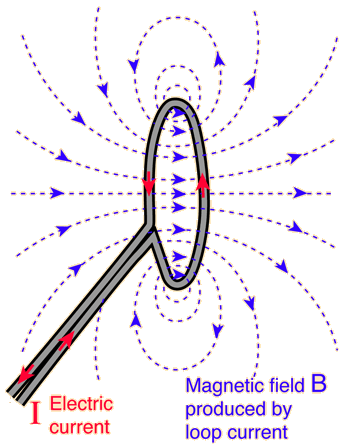
For a single circular with radius \( R \) loop like this (figure from here), located at \( x-y \) plane. Any point on it has coordinates \( \mathbf{l} = (R\cos \theta, R\sin \theta, 0) \). Then the magnetic field, at point \( \mathbf{x} = (x, y, z) \), it results in is $$ \mathbf{B}(x, y, z) = \int \begin{bmatrix} dB_x \\ dB_y \\ dB_z \end{bmatrix} = \int_{0}^{2\pi} \frac{ \mu_0 i }{ 4 \pi } \frac{R d\theta}{ r^3 } \begin{bmatrix} z \cos \theta \\ z \sin \theta \\ R - x \cos \theta - y \sin \theta \end{bmatrix}, $$ where \( r = \sqrt{ (x - R \cos \theta)^2 + (y - R \sin \theta)^2 + z^2 } \).
The left panel draws magnetic field on \( x-z \) plane, with vertical-axis to be \( z \), horizontal to be \( x \). The right panel draws field on \( (x, y, 0.1 ) \) plane. With with vertical-axis to be \( y \), horizontal to be \( x \).
Simulator
Questions
- The problem (see course notes) is expressed in terms of normalized, dimensionless coordinates, \(X, Y, Z \). What determines the length scale?
- For \( (0, 0, Z) \), in which direction is the field? Along this axis, how does the magnetic field vary, increasing or decreasing, the further away we go in \( Z \)?
- If we are very close to the wire, what does the field configuration approximate?
- For a semi-infinitely long solenoid, on the z-axis, what is the relationship between the magnitude of magnetic fields on the face compared with in the interior? (Why? Proof is simple.)
- For the configuration on the right, if we measure at \(Z / R = 0.1 \), where is the absolute magnitude of the field largest?
- If we are very far away from the loop, what does the field configuration look like?
- Based on last question, consider the magnetic dipole moment of a current-carrying loop to be \(\mu = i A \), wher \( A \) is the cross-sectional area of the loop. On the z-axis, do you find a relationship between the magnitude of the magnetic field and the magnetic dipole moment?